
captions have transformed from simple text overlays into a powerful communication tool that shapes how people consume content today. In the United States, where silent scrolling dominates social media and virtual events attract global audiences, captions drive clarity, retention, and inclusivity. They don’t just repeat spoken words. They strengthen Global event accessibility, support a smarter Multilingual event strategy, and enhance overall Language support for events. When combined with Real-time captions and Live interpretation services, they create a seamless viewing experience. Simply put, captions help brands connect with diverse audiences, improve engagement metrics, and build trust in an increasingly competitive digital landscape
Captions and Multilingual Event Strategy: The Ultimate Guide to Global Event Accessibility and Engagement
captions
Captions are no longer just text at the bottom of a screen. They are the backbone of modern global events. When you design events for international audiences, captions become part of a powerful Multilingual event strategy and a smart Event localization strategy. They support Real-time captions, improve clarity, and strengthen the Global attendee experience. In large conferences, Live interpretation services and Simultaneous interpretation work alongside captions to create full understanding.
Today, organizations treat captions as a tool for Global event accessibility. They connect them with Hybrid event localization and Multilingual digital signage to ensure everyone follows along. Strong captions also improve Event content repurposing because sessions can later turn into Localized video recordings. When done correctly, captions support End-to-end localization and increase Global audience engagement across borders.
What Are Captions and How Do They Work?
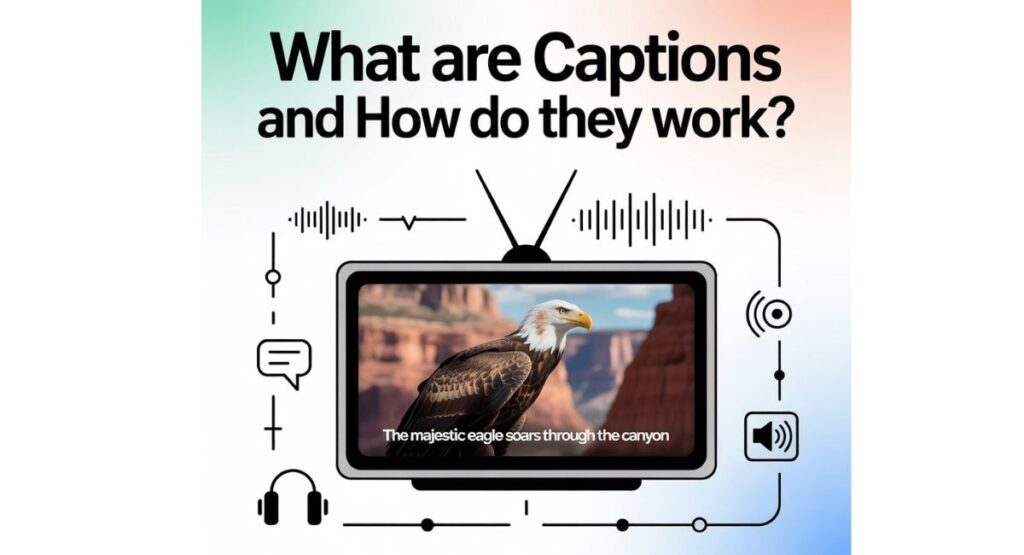
Captions convert spoken words into visible text. They include dialogue, speaker names, and sound effects. In global events, captions combine with Event translation services to support multiple languages. This approach fits into a wider Pre-event marketing localization plan and builds strong Attendee journey localization. Many companies now use an Enterprise localization platform to manage captions across sessions.
Modern systems rely on AI supported by Human-in-the-loop translation. This method balances speed with quality. Experts often compare AI vs human translation for events to decide the best workflow. Below is a simple comparison table used by many event planners.
| Method | Speed | Accuracy | Best For |
| AI Captions | Fast | Medium | Short webinars |
| Human Editing | Moderate | High | Legal or medical events |
| Hybrid Model | Balanced | Very High | Large conferences |
Why Captions Matter for Accessibility in the United States
In the United States, captions help meet Event accessibility standards and legal requirements. Many organizations follow Accessibility compliance events guidelines under ADA and FCC rules. However, compliance is only the beginning. Captions also improve Event conversion rates because audiences feel included from the start.
Strong captions support On-site multilingual support and Multilingual conference support. They also help companies maintain Brand consistency across languages. When event planners treat Language as infrastructure, they create true Strategic global engagement. This mindset transforms captions from a feature into a business advantage.
Why Captions Instantly Transform Viewer Engagement
Scroll anywhere online and you’ll notice one thing fast: Captions grab attention before sound does. In today’s silent-scrolling culture, Captions act as visual anchors that boost video accessibility and improve audience retention. When you add clear text overlays, viewers stay longer. They understand faster. They don’t feel lost. In fact, studies from https://www.w3.org/WAI/media/av/captions/ show captions improve comprehension for diverse audiences. However, strong Captions don’t just display words. They reinforce tone, clarify jargon, and subtly guide emotion. Think of them as a quiet narrator who never interrupts yet always supports the story.
How Captions Strengthen SEO and Global Reach
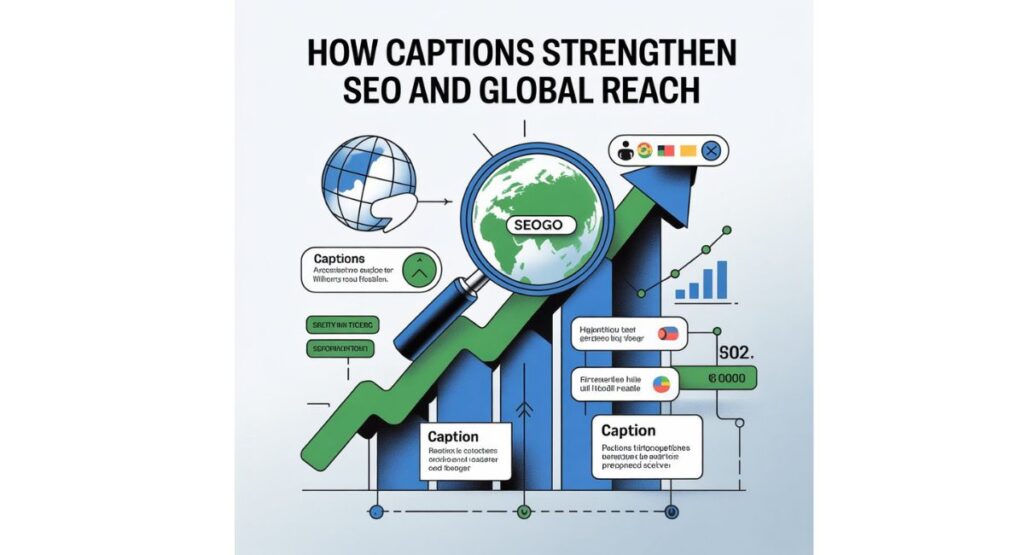
Want more traffic? Start with Captions. Search engines can’t watch videos, yet they can index text. That’s where Captions convert speech into crawlable content, boosting video SEO and expanding multilingual reach. For example, a captioned tutorial ranks higher because Google understands context better. Moreover, Captions increase watch time, which signals quality. When you localize Captions into multiple languages, you unlock new markets without reshooting content. It’s like adding subtitles to a blockbuster film. Suddenly, the world becomes your audience.
Smart Ways to Optimize Captions for Maximum Impact
Great Captions don’t happen by accident. Keep sentences short. Match timing precisely. Use natural phrasing instead of robotic transcripts. Add light formatting for clarity. Most importantly, review manually. While AI speeds things up, human editing protects brand voice and ensures accuracy standards. Done right, Captions feel invisible yet powerful.
How Captions Improve SEO and Global Event ROI
Search engines read text, not sound. Captions give search engines rich data. This improves ranking and increases Global event ROI. When combined with Localized content distribution and Region-specific marketing, captions attract traffic from multiple markets.
Captions also help with Registration page localization and Multilingual ticketing systems. Clear text increases trust and boosts sign-ups. Many companies report that adding captions raised their Event conversion rates by over twenty percent. Captions also support Localized lead nurturing after the event ends.
Captions and Social Media Growth in the U.S. Market
Social media users often watch videos without sound. Captions hold attention in the first few seconds. This improves watch time and sharing. When paired with Localized event marketing and Cross-border event strategy, captions expand reach.
During Multilingual hybrid events, captions support Global audience engagement across time zones. They also connect with Multilingual surveys after sessions. These surveys help planners refine their Data-driven language strategy for future campaigns.
Types of Captions: Open, Closed, Live, and AI-Powered
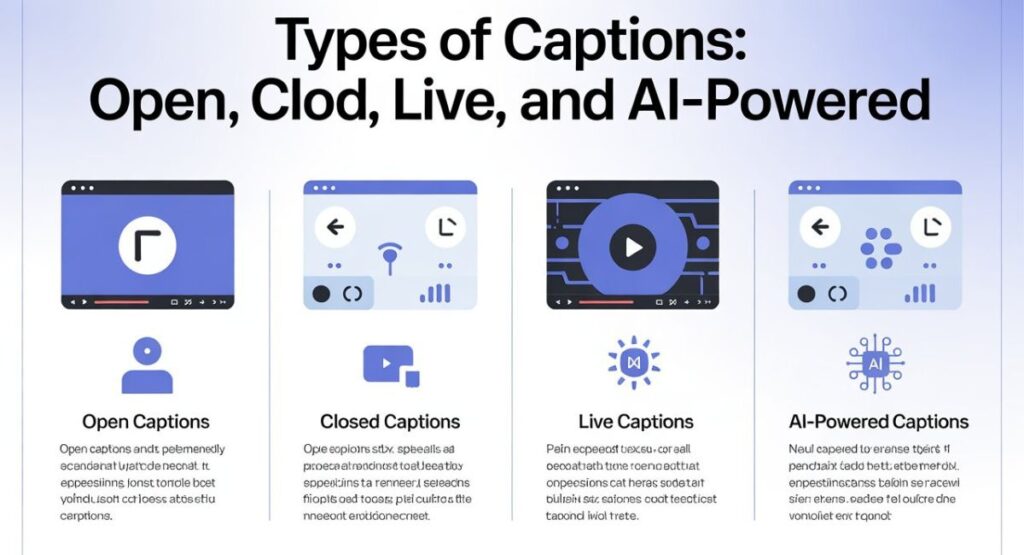
Open captions stay visible on the screen. Closed captions allow users to turn them on or off. Live event captioning services provide instant text during sessions. Many companies use Professional interpretation services alongside captions for full clarity.
Captions also integrate into an Enterprise-grade translation platform. This supports Enterprise translation management and Language workflow automation. With Scalable localization workflows, event teams manage hundreds of sessions efficiently. These systems form part of a Global event localization platform.
AI Captions vs Human Captioning
AI captions work fast and reduce cost. However, they may miss Cultural nuance in translation. Human editors correct tone and industry terms. That is why many planners choose a hybrid approach.
This approach strengthens End-to-end event localization solution planning. It ensures accurate Localized speaker bios and clear Multilingual registration flow instructions. In high-stakes industries, accuracy protects reputation and trust.
Best Practices for Writing High-Impact Captions
Strong captions use short sentences. They match speech timing. They avoid clutter. Event planners often align captions with Multilingual digital signage and Event app localization to create smooth navigation.
Captions should connect with During-event language infrastructure. They must also support Post-event content translation and Localized video recordings. Consistency across touchpoints builds confidence and strengthens the overall Event lifecycle management strategy.
Captions for Businesses, Educators, and Event Hosts
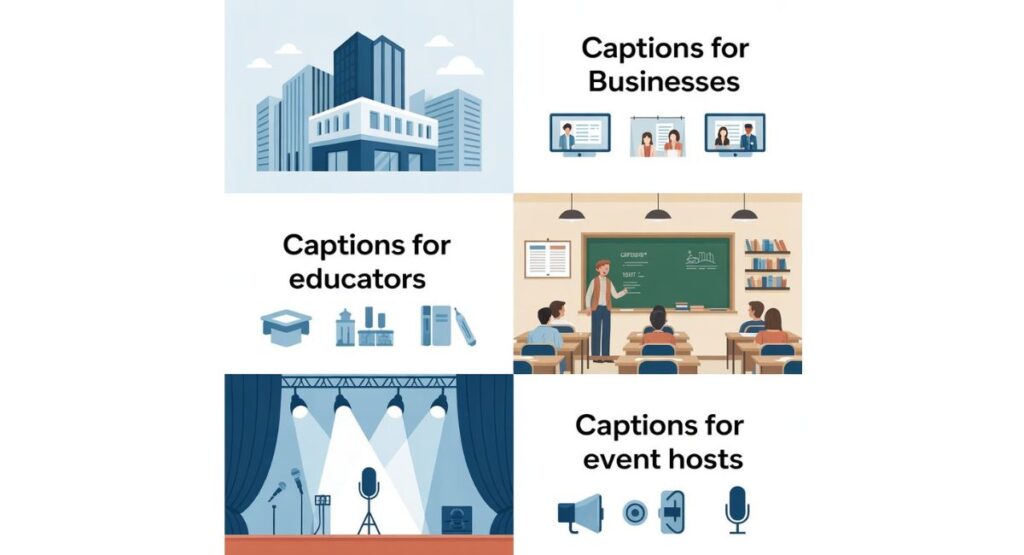
Businesses use captions in webinars, training, and product launches. Universities rely on captions for Global event accessibility. Captions support Post-event engagement strategy and improve Localized lead nurturing.
For global conferences, captions combine with Multilingual event services and Event translation company partnerships. This ensures Market-specific attendee journey design. When integrated correctly, captions drive measurable Global event ROI and lasting audience trust.
Common Captioning Mistakes That Hurt Performance
Poor timing breaks focus. Inaccurate spelling damages credibility. Ignoring sound cues confuses viewers. These mistakes weaken the Global attendee experience and reduce trust.
Many errors occur when teams ignore Language support for events planning. Without clear workflows, captions may not align with Hybrid event localization or Multilingual conference support efforts. Careful quality checks prevent these issues.
The Future of Captions and End-to-End Localization
The future belongs to integrated systems. Captions will connect directly with Enterprise localization platform dashboards. They will sync with Multilingual digital signage and real-time analytics.
As companies adopt End-to-end localization and stronger Event lifecycle management, captions will guide full Attendee journey localization. Events will no longer treat language as an afterthought. Instead, captions will power Strategic global engagement and sustainable growth across markets.
In simple words, captions are not just text. They are the foundation of global communication. When combined with a strong Multilingual event strategy, they unlock true global impact.
AI Caption Generator & Multilingual Event Experience: The Complete 2026 Guide
What Is an AI Caption Generator and How Does It Work?
- AI speech recognition explained
- NLP & machine learning role
- Auto captioning vs manual captions
- Subtitle vs caption difference
Why Captions Are Just the Beginning of Multilingual Event Experiences
- Beyond basic captions
- Accessibility compliance (ADA, WCAG)
- Engagement & retention impact
- Real-time interpretation
The Complete Multilingual Event Lifecycle (From Planning to Post-Event)
- Pre-event language planning
- Live translation & captioning
- Post-event repurposing (translated clips, global reach)
- Analytics tracking
Step-by-Step: How to Generate AI Video Captions in 4 Easy Steps
- Upload video
- AI processing
- Editing & customization
- Export formats (SRT, VTT, TXT)
AI Video Translation vs AI Caption Generator – What’s the Difference?
- Lip-sync translation
- Subtitles vs dubbed voice
- When to use which
- Cost & scalability comparison
Best Practices for High-Accuracy AI-Generated Captions
- Audio quality optimization
- Speaker separation
- Punctuation improvements
- Manual review importance
SEO & Engagement Benefits of Using Captions
- Watch time increase
- Silent viewing trend
- Social media algorithm boost
- International audience growth
Can ChatGPT or Free AI Tools Replace Professional Captioning Tools?
- Limitations of generic AI
- Accuracy comparison
- Privacy concerns
- When professional tools are required
FAQs About AI Caption Generators & Multilingual Events
- How accurate are AI captions?
- Do captions improve SEO?
- What export formats are supported?
- Can I edit captions after generation?
- Are AI captions good for live events?
- How much does AI captioning cost?
Captions: The Complete 2026 Guide to Better Engagement, SEO, and Accessibility in the USA
captions
Start strong. Captions aren’t decorative text. They’re a growth engine for modern content. In the USA, where silent autoplay dominates social feeds, captions drive clarity, retention, and accessibility. This section introduces video captions, closed captions, and subtitle variations while defining why captions now shape digital performance.
What Are Captions and How Do They Work?
Many creators confuse subtitles with captions. However, captions include dialogue, speaker cues, and sound descriptions. Here, explain open vs closed captions, real-time vs pre-recorded formats, and how speech-to-text systems generate captions. Highlight captioning services, live captions, and automated workflows used across American platforms.
Why Captions Matter for Accessibility in the United States
Accessibility isn’t optional. Under the https://www.ada.gov/ guidelines and FCC regulations, captions protect equal access. This section explores ADA compliance, WCAG standards, and inclusive design. Emphasize accessibility compliance, ADA captions, and inclusive media strategies relevant to U.S. businesses and educators.
How Captions Improve SEO and Organic Visibility
Search engines can’t watch videos. They read captions. Explain how captions increase keyword relevance, dwell time, and indexing depth. Reference Google’s documentation at https://developers.google.com/search/docs. Include video SEO, search indexing, and metadata optimization tied directly to captions.
Captions and Social Media Growth in the U.S. Market
Attention spans shrink fast. Captions stop the scroll. Cover Instagram, TikTok, YouTube, and LinkedIn usage trends in the United States. Discuss silent viewing habits, autoplay behavior, and engagement metrics. Include social media captions, watch time, and platform algorithm signals.
Types of Captions: Open, Closed, Live, and AI-Generated
Not all captions work the same. Break down open captions vs closed captions, CART services for live events, and AI caption tools. Compare manual editing versus automation. Use AI captions, real-time captioning, and professional workflows as core subtopics.
AI Captions vs Human Captioning: Which Is Better?
Explore accuracy, nuance, brand tone, and legal risk. Discuss cost differences and scalability for U.S. enterprises. Include examples from webinars, corporate training, and marketing campaigns. Emphasize human-in-the-loop editing and quality assurance standards.
Best Practices for Writing High-Impact Captions
Great captions feel natural. This section covers timing, readability, font styling, character limits, and tone. Provide U.S.-centric examples. Include formatting tips, ADA-safe color contrast, and clarity principles. Focus on caption formatting, engagement optimization, and conversational writing techniques.
Captions for Businesses, Educators, and Event Hosts
From universities to SaaS startups, captions drive results. Discuss corporate training, e-learning modules, webinars, conferences, and product demos. Explain ROI metrics and compliance needs specific to U.S. organizations. Highlight enterprise captioning, multilingual captions, and event accessibility strategies.
Common Captioning Mistakes That Hurt Performance
Even strong videos fail with weak captions. Address sync errors, poor grammar, overlong lines, and ignoring sound cues. Explain how mistakes reduce credibility and retention. Include examples and quick fixes. Mention caption accuracy, quality control, and editing workflows.
The Future of Captions in the United States
Technology evolves quickly. Predict AI advancements, voice cloning, multilingual auto-translation, and regulatory expansion. Discuss how captions will integrate with AR, virtual events, and immersive media. Use next-generation captions, AI localization, and predictive content workflows.
Frequently Asked Questions About Captions
Include structured FAQ schema opportunities:
- Do captions improve SEO?
- Are captions legally required in the USA?
- What’s the difference between subtitles and captions?
- How accurate are AI-generated captions?
- How much do professional captioning services cost?
FAQs
1. Do captions really improve engagement?
Yes, captions significantly improve engagement. Many viewers watch videos without sound, especially on social media. Captions help them follow the message instantly. They also increase watch time, which supports Global audience engagement and boosts overall performance metrics.
2. Are captions legally required in the United States?
In many cases, yes. U.S. laws such as ADA and FCC guidelines require accessible media in public and educational settings. Captions help organizations meet Global event accessibility standards and ensure equal access for all viewers.
3. What is the difference between captions and subtitles?
Captions include spoken dialogue plus sound cues like music or background noise. Subtitles usually translate speech only. Captions are more detailed and better suited for full Language support for events and accessibility needs.
4. Can AI generate accurate captions?
AI tools can produce fast results, especially for basic content. However, human review improves tone, technical vocabulary, and context. Combining automation with quality checks ensures better accuracy and supports End-to-end localization strategies.
5. Do captions help with SEO?
Yes, captions improve search visibility because search engines read text, not audio. Adding captions increases keyword relevance and discoverability. When aligned with a strong Event localization strategy, captions also expand reach into multilingual markets.
Conclusion
Captions are no longer optional in today’s digital and event-driven world. They improve clarity, increase engagement, and support inclusive communication across diverse audiences in the United States and beyond. When integrated into a strong Event localization strategy and supported by Real-time captions, they enhance the entire attendee journey. Businesses that align captions with Global audience engagement goals and End-to-end localization efforts see stronger trust, higher retention, and better performance metrics. In simple terms, captions are not just text on a screen. They are a strategic asset that strengthens communication, expands reach, and delivers measurable impact in every modern content experience.

1 thought on “captions”